


|
|---|


Saturday, October 2, 2010


Wednesday, September 29, 2010
Beautiful Girl Hand Painted - Oil on Canvas Painting

Monday, September 27, 2010

Friday, August 6, 2010
Body Painting: The Zero Movement - CocaCola Style Painting


Thursday, July 1, 2010
Body Art - Body Painting Culture

What for? A tricky question, but everybody has his or her own reason, actually, there are a lot of them: now people want to look better, earlier it was a necessity in order to get rid of enemies and frighten them. Actually, everybody has the right onto self-expression and if someone wants his or her body to be painted, it doesn’t matter. The deal is – we should feel the difference and a vague measure between a vulgar and a stylish appearance.

Body art can be divided into the following arts: tattoos making, body piercing and body painting. Very often artists take a nude model and paint her of his body with various types of paints of different colours and nowadays it is extremely popular among celebrities (especially tattoo making).


I like body painting very much, as for me it the only one way, to paint something on your body and to wash it with a help of water and soap in a week or in a day. Very often body painting implies usage of the additional materials, such as clay, flowers etc. Body painting is made not on the entirely nude body, a model can have a bra or pants, because body painting deals with a small part of the body. I adore their technique in creating situation and pictures in the medium- so-called thematic pictures. When a model is only a continuation of the reality.


source : http://chicstories.com/history/body-art-culture/
Saturday, March 27, 2010
Paint Me!! Beautiful Face Painting

Creative Face Painting - Nice Face of Woman with splashes of many color painting looks as nice arts / painting
Saturday, March 20, 2010
Wild Animal in The Jungle Oil Painting

Topart co. Ltd. Is manufacturer and exporter of both oil Paintings on canvas by letterman / board in various styles or subjects in museum quality, high-quality, medium quality and commercial quality at competitive prices. We have a studio and factory. Our company found in 1995, we have more than 3000 artists, who can paint every kind of subject. Our products are widely accepted among European and American markets.

Violin in the back of a woman - Body Painting

The nice body painting, Violin in the back of a woman - Body Painting
Friday, March 19, 2010
Graffiti Sketches - Form of The Statue on The Hill
 Here is Graffiti Sketches - Form of The Statue on The Hill
Out Open Windows - Oil on canvas by Jude Gribel
 Here is Out Open Windows - Oil Paintings on canvas by letterman ( Jude Gribel )
Out Open Windows
oil on canvas
60 x 48 in.
$4500
available at Bau-Xi, Vancouver
Sunday, February 28, 2010
"Winterized" - Our Favourite Painting

I Think Tis painting was made with watercolor style. You'll recognize, of course, the now even more icy couple from Grant Wood's American Gothic at left. And at right, below, you can see La Soif (The Thirst) by William Adolphe Bouguereau, and at left, below, you'll find it's altered counterpart, I Triple Dog Dare Ya.
To see more watercolor painting collection, please click here watercolor painting
Famous Watercolor Painting - Beautiful Woman Was Sleeping

Saturday, February 27, 2010
Arts of Painting - Exploring the Artist Identity
 Art Paintings Process
The painting processes in this research endeavour to study the artist identity of the artist through the exploration of consciousness. The basic components of what; where, when; how and why they take place will be described in the following applications, which form a personal account.
These processes have been chosen instead of other media because of the quality of paint's immediate and fluid response. Despite a background in ceramics, art paintings is where my passion lies.
Processes
What the Art Paintings Will Comprise
In my exploration, six art paintings will be undertaken. These will be abstract art paintings and figurative paintings. I will use alternative surfaces. The paintings will include canvases stretched professionally with concrete underlay (thick black plastic).
The dimensions of each art painting will be uniform: 120 x 70x 5 cm. The media used will include oil paint, enamel, oil sticks, Black Japan stain, shellac, pastel, charcoal and ink. The primary artistic focus in this process will lie in the use of alternative materials in painting and in the use of alternative surfaces. Boundaries may be intentionally pushed through the use of construction materials to create aesthetics on surfaces not intended for this purpose.
When the Painting Will Take Place
The proposed plan involves painting every second Tuesday and every Thursday for a period of six weeks. This art painting will occur at night in two to three hourly timeslots.
Where They Will Take Place
The space will consist of a studio set-up in a lock-up garage. For the purposes of the research, the computer and reference materials will be set up on one side of a garage space, and the work bench with art painting materials on the other. I plan to be able to move quickly and freely between both.
How They Will Occur
The intention is to include a timetable of art painting processes, which will consist of certain times in the following months. Ideas of setting a limit on the painting time have been considered.
Dialogue with Art Paintings
The personal dialogue processes approached in this research combine elements of Heuristic research, but allow for an individual account.
These processes are based on the internal search mechanisms present within the creative-self processes The processes relate to a conversation or dialogue that takes place between the researcher, artist and a higher consciousness of either the self, an artwork or other object studied closely. Many artists and art therapists have utilized these methods in their research and inquiry.
Why the Dialogue Will be Undertaken in This Manner
The dialogue process is intended to provide a different level of consciousness. It is anticipated that I will connect with my art paintings through the processes of dialogue. The dialogue may inform me on levels unavailable to me experientially.
What the Dialogue Will Comprise
This process is intended to encompass a journey into art painting. The aim is to literally enter into the art paintings through passages of different levels of consciousness. In order to make the space available to connect with these other levels of consciousness, the following will be utilized: indwelling; a search of the self through thought; meditation and contemplation. The insights may come through hearing the words in my mind, intuition, or new concepts emerging from or into internal frames of reference.
Where the Dialogue Will Take Place
This process is an internal one, while the external and inter-objective realities in my surroundings may have bearing on the internal mechanisms. The proposed dialogue will occur in the studio space designated for writing this research. The set-up of the computer on one side and the art paintings on the other is intentionally designed towards easy access to writing when dialogue occurs. When the Dialogue Will Take Place
The method of dialogue within this research will be approached using a lack of structured timetable or schedule. As I have not attempted this process before, I am unsure of whether it will be able to fit into a time-frame. I am unsure of whether I can summon dialogue at will; or whether it will emerge in an indiscriminate manner.
How the Dialogue Will Occur
This is largely unable to be determined at this point in time. There is a commitment to a total immersion in the processes of this inquiry and it is likely that the dialogue will naturally emerge from the art paintings through channels due to the immersion process. It is anticipated that the creation of the unique personal space for communication with my art paintings will reveal and allow for documentation of how the process occurs.
Reflection on Art Paintings
Why the Reflection Will be Undertaken in This Manner
The reflection process formulates the basis for the intimate connectivity of the processes of art paintings and dialogue. It forms the fabric from which the evaluation cloth is cut. The sacred witness will allow the space and time to measure the experience and to dwell on the emergence of new information.
The reflection process aims to draw the art paintings and dialogue processes together and provide the stand-back viewpoint, indispensable to making art paintings and primordial self- inquiry.
What the Reflection Will Comprise
The reflection process in this research will comprise transpersonal processes as a method of self-inquiry. It will evoke notions of the witness. These reflection processes will present a unique witness account of the experience of art painting, the dialogue experience and the overall experiences.
The observations of thoughts, emotions, dreams, dialogue and art painting processes provide the foundation from which to evaluate the personal interior experience.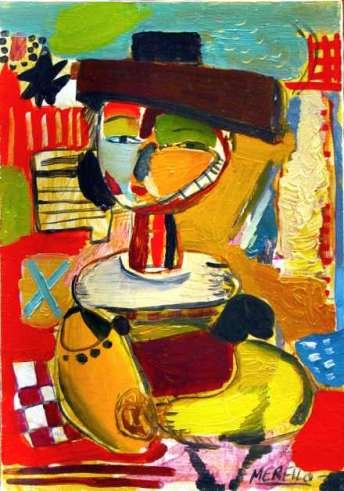
The reflection is anticipated to take place within the transpersonal self -this being wherever the art paintings and dialogue processes are taking place. They may take place in other areas of life, such as times of driving, walking, meditating and working.
When the Reflection Will Take Place
Much like the whereabouts of the reflection processes, the time-frame of this process encompasses all other processes in this research. It is predictable that I will bear witness to my art paintings and my dialogue processes. The witness will be present when I make the connective leaps in consciousness and when the intellectual synapses jump into action. Thus, the internal observer will have to be on duty at all times, knitting the components of my processes together. These observations can then be evaluated into a unified and presentable critique.
How the Reflection Will Occur
The reflection processes aim to transcend the art paintings and dialogue states of consciousness. Reflection is anticipated to occur through the watchful gaze of the transpersonal witness. I will endeavour to consciously manifest the witness during times of art painting and dialogue. This will involve dis-identifying with the art paintings and dialogue processes.
Findings of the Exploration Into the Artist Identity
The basic components of why, what, where, when and how investigated in the art paintings and dialogue and reflection applications can be located in the art paintings themselves and in some of the text and explanation of each of the art paintings on the website.
Friday, February 26, 2010
DAVID LETTERMAN - Late Night Show Host Oil Painting

This is an oil paintings on canvas by letterman with title "DAVID LETTERMAN" Late night Show Host.
to see more oil paintings, click here oil paintings
Black and White Art on The Wall - Adds Drama and Sophistication

The dining room had walls the color of terracotta pots and a classic Greek keystone pattern ran around the bottom of glossy black crown molding. The wall had at least a dozen black and white photos of architectural details. Obviously I was impressed. Any moment Humphrey Bogart and Lauren Bacall could have walked through the door!
You might not be ready for something this dramatic. However the look of black and white art on a wall can make a highly sophisticated statement. When you are shopping for black and white images, keep in mind the main elements that viewers notice are line and mass.
The size of the image will determine the level of intrigue that the viewer experiences. For example, a series of small images will invite closer inspection and a single large image will increase the power of the subject.
A few suggestions for finishing your black and white artwork:
 Suggestions:
- Look for mats in subtle shades from beige to rose.
- Try double mats with a narrow liner of a bright color such as scarlet.
- Try mats with colored edges that are less expensive than double mats.
- Matt black frames won’t overpower the image as would a gloss finish or gold frame.
- A white frame can create a totally different look for the image
- Remember that you are about to invite drama into your home – If you see Bogie or Bacall don’t be surprised.
Friday, February 19, 2010
Body Painting Not Just For Concerts Anymore

To looks more body painting galleries, please click here - body painting
Wednesday, February 17, 2010
Picasso - Father of Modern Art
 Modern art, incorporates canvas art, sculpture, print, and all the other new forms of twentieth century art. Scholars and historians rarely agree, as to the exact point when modern art began. Therefore, the term generally refers to all art, produced in America and Europe, during the nineteen hundreds. In addition to a hand full of other countries, which were primarily influenced by the West. This was a time when Artists were introducing new materials, new techniques and new concepts.
Pablo Picasso was born in Malaga, mainland Spain. Pablo Picasso was a child prodigy, by the age of fourteen his technical skill was incredible. In 1895, his father became an art teacher at the Academy of Fine Art in La Coruña. Picasso was entered into the advanced classes quickly. He completed the entrance exam, which took most at least a month, in one day. Two years later, he began to study at the Madrid Academy. Picasso left soon after, dissatisfied, and returned home. Between 1900 and 1904, Picasso shifted between Paris and La Coruña. After four years of moving back and forth, Picasso finally made his home in Paris. This would be where he would live and work for most of his life.
From 1904, Picasso encountered many different art forms, showing great interest in the style of Henri Toulouse and African Art. Since his first visit to Paris, Picasso loved to paint the Parisian nightlife and café scenes, which generally, included a menagerie of circus performers and social outcasts. Some feel that Picasso was displaying empathy with the entertainers and outcasts he portrayed, like the Clown. The Clown is recognized inside the Big Ring, yet falls into obscurity, the second he removes his Clown face. Society pays the Clown to be entertained. Nobody is particularly interested in his real face, or feelings. Before Artists broke free of those Artistic restrictions, which had previously bound them, there was little difference between the Clown, and the Artist.

The incongruities of Les Demoiselles d'Avignon proved too much for many of Picasso's contemporaries. Matisse is even believed to have accused Picasso of ridiculing the new, modern art movement. Curiously, today, many art historians and scholars regard this piece as the beginning of Cubism. The year of 1907 is also known to many as Picasso's African period. At first, Picasso rebuked the analogy of his work with African Art. However, later, he agreed that African Art had been greatly influential upon him, and his work. While some scholars believe that African Art was the primary catalyst for this rapid and drastic change in form and style, others believe it was Cézanne who provided this catalyst.
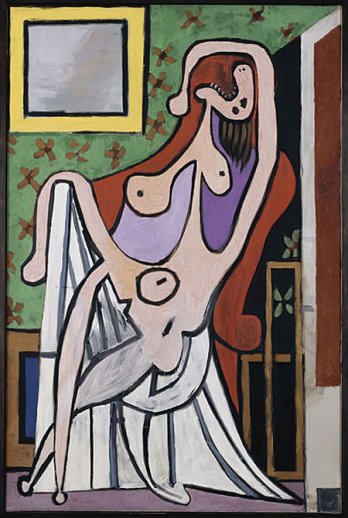
Woman Face Expression Oil Painting
 I think this is a nice one of Oil Painting, Woman Face Expression Oil Painting. An oil painting is an expression on canvas that can reflect many things, from real life to abstract, and it one of the greatest gift ideas. Painting in oil is an almost lost art medium in the burgeoning digital age. Contrary to popular belief, painting in oil does not require that the artist to be a professional.
Shades of Violet - Woman Expression Oil Painting
 "Violet" Woman Expression Oil Painting by Pino. One of my beautiful oil paintings, I love the skin tones, and expression on the face. To see more oil paintings, please click here oil paintings


